Prescription drug prices in the United States remain significantly higher than in the European Union. The main reason lies in how each system approaches pricing: while the U.S. relies largely on market-driven mechanisms, EU countries use centralized negotiation and stricter regulation.
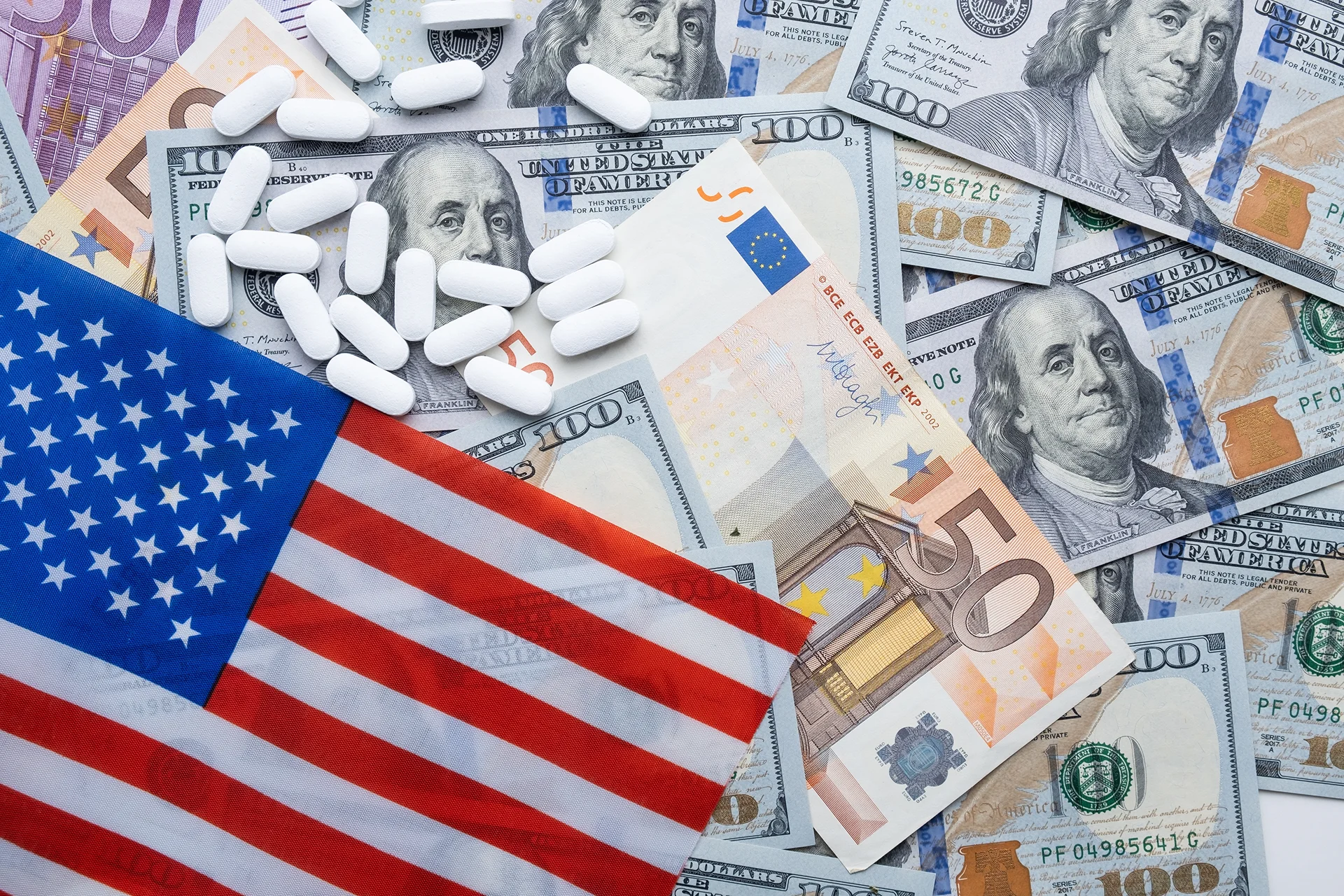
Under President Donald Trump’s “The Great Healthcare Plan,” the U.S. has introduced aggressive price-cut deals and a new direct-to-consumer platform, TrumpRx.gov. The goal is ambitious – bringing American drug prices down to the “world’s lowest” levels.
How U.S. health insurance works
Most Americans receive health coverage either through private insurance (often employer-sponsored) or through public programs such as Medicare and Medicaid.
Private insurance typically involves multiple cost-sharing elements, including premiums, deductibles, copayments, and coinsurance. Once a patient reaches their annual out-of-pocket maximum, the insurer covers 100% of eligible healthcare costs for the remainder of the year.
Prescription drugs are covered through formularies – lists of medications that insurers agree to reimburse. These drugs are grouped into tiers, which determine how much patients pay out of pocket.
- Tier 1: Generic drugs
- Tier 2: Preferred brand-name drugs
- Tier 3: Non-preferred brands follow
- Tier 4: Specialty drugs used for complex conditions
What insurers cover and to what extent
Both Medicare and private insurers cover a wide range of medications, but access is often tightly managed. Common tools include prior authorization, step therapy (requiring patients to try cheaper alternatives first), and quantity limits.
Even when drugs are covered, patients may face substantial out-of-pocket costs – especially for high-priced specialty treatments – until they reach their coverage threshold.
Because the U.S. system is largely market-based, brand-name drugs, especially newer biologics and specialty therapies, often remain expensive despite insurance coverage.
In contrast, EU countries rely on national health authorities to negotiate prices directly with manufacturers. While this can lead to delayed or more limited access to certain high-cost drugs, it also keeps overall prices significantly lower.
Changes under Trump’s “The Great Healthcare Plan”
Since returning to office, President Trump has promoted a strategy focused on reducing drug prices through most-favored-nation-style agreements with pharmaceutical companies, alongside the launch of TrumpRx.gov.
A central pillar of this strategy is the Most Favored Nation (MFN) policy, which ties U.S. drug prices to the lowest prices paid by other developed countries. In practice, this means that if a pharmaceutical company offers a lower price in Europe or another reference market, it could be required to offer the same or similar price in the U.S.
According to the administration, these measures could reduce prices for many widely used drugs by 300 – 500%, with some targeted cuts of up to 80 – 90%.
A key feature of the plan is a direct-to-consumer model. Instead of relying solely on insurers, the government negotiates lower prices and provides payments directly to patients. These funds can then be used to purchase medications or insurance coverage.
This approach specifically targets widely used but high-cost drugs, such as Ozempic and Wegovy. Monthly prices for these treatments have reportedly dropped from over $1,000 to around $350 on average, with some options available for as little as $149 – $199.
How the U.S. still compares to the EU
Despite recent reforms, independent analyses suggest that U.S. drug prices remain higher than those in many EU countries, and the claim of achieving the “world’s lowest” prices continues to be debated.
The difference is structural – it is not only about negotiation power but reflects fundamentally different pricing models.
Systems in European countries typically combine several mechanisms to control costs. These include centralized price negotiations, health technology assessments (HTA), and reference pricing, where drug prices are benchmarked either against similar therapies or against prices in other countries.
Increasingly, many EU countries are also moving toward value-based pricing, where the price of a drug is linked to the clinical benefit it delivers, such as improved survival or quality of life. This approach aims to ensure that healthcare systems pay for outcomes rather than volume.
In contrast, the U.S. has historically relied more on market-based pricing, shaped by competition, patent protection, and negotiations between manufacturers, insurers, and pharmacy benefit managers. While recent reforms, including Trump’s most-favored-nation approach, introduce elements of international benchmarking, the system remains less centralized.
However, the MFN policy is beginning to blur this distinction by directly linking U.S. prices to those in Europe. This creates a new global dynamic: pharmaceutical companies may become less willing to offer lower prices in European markets if those prices are used as a benchmark for the U.S.
Early signals suggest that this could have significant implications for Europe. Drug manufacturers are already reassessing their pricing and launch strategies, potentially delaying the introduction of new medicines or reconsidering pricing levels in lower-income EU countries.
Another critical issue is price transparency. Many European countries rely on confidential discounts and rebates negotiated with manufacturers. If U.S. prices are tied to these figures, there is growing concern that such confidentiality could erode—making negotiations more complex and potentially pushing official prices upward.
You can read more about different pricing models in our article focused on drug prices and the need for sustainable healthcare expenditure.
At the same time, newer and more complex therapies, such as biologics, gene therapies, and precision medicines, are pushing all systems to evolve. These treatments often come with high upfront costs and uncertain long-term outcomes, making traditional pricing models less effective.
As a result, hybrid approaches are emerging. These combine elements of value-based pricing, outcomes-based agreements (where payment depends on real-world performance), and international price benchmarking to better balance affordability with incentives for innovation.
Ultimately, there is no single “best” pricing model. The U.S. and EU represent different points on a spectrum: one prioritizing market dynamics and faster access, the other emphasizing cost control and system sustainability. Policies like MFN, however, are starting to connect these systems more directly, meaning that pricing decisions in one region may increasingly affect patients and payers in another. Trump’s reforms may narrow the gap, but they do not fundamentally change the underlying architecture of how drug prices are determined.
Sources
-
Vokinger, K. N. et al.,Negotiating Drug Prices in the US—Lessons From Europe, JAMA Health Forum, 2022, available at: https://jamanetwork.com/journals/jama-health-forum/fullarticle/2799713
- Dabbous M, François C,Chachoua L, Toumi M., President Trump's prescription to reduce drug prices: from the campaign trail to American Patients First, available at: https://pmc.ncbi.nlm.nih.gov/articles/PMC6407585/
- U.S. White House,Fact Sheet: President Donald J. Trump Launches TrumpRx to Bring Lower Drug Prices, February 2026, available at: https://www.whitehouse.gov/fact-sheets/2026/02/fact-sheet-president-donald-j-trump-launches-trumprx-gov-to-bring-lower-drug-prices-to-american-patients/
- New York Times,Trump Promised the “World’s Lowest” Drug Prices. We Checked the Numbers, March 2026, available at: https://www.nytimes.com/2026/03/18/world/europe/trumprx-drug-prices-really-cheapest-world-comparison.html
- Reuters,Drugmakers brace for Europe pricing fight after Trump’s US price-cut deals, January 2026, available at: https://www.reuters.com/legal/litigation/drugmakers-brace-europe-pricing-fight-after-trumps-us-price-cut-deals-2026-01-08/
- RISE,Regulatory roundup: Trump unveils a new health care plan to lower costs; Medicare paid $28.8B in improper payments in FY2025; and more, January 2026, available at: https://www.risehealth.org/insights-articles/article/regulatory-roundup-trump-unveils-a-new-health-care-plan-to-lower-costs-medicare-paid-288b-in-improper-payments-in-fy2025-and-more/
- Lyfegen,Value-Based Drug Pricing Europe vs US, 2025, available at: https://www.lyfegen.com/post/who-does-it-better-assessing-a-value-based-drug-price-in-europe-vs-the-us